Sailing with a Dog: Practical Guide for Cruisers
Do you want to bring your dog sailing with you? Sailing with a dog can make things a bit more complicated, but trust me, it is well worth it!
We have been sailing over 11 years and living on a boat with our dog full-time for over 4 years. Our dog, Mangaux, has been with us the entire time (he’s around 12.5 years old).
Mangaux has adjusted quite well to life at sea, although he does like the calm seas much better! He loves feeling the breeze in his ears, and getting to land for beach walks are his absolute favorite!
In this article, I’ll cover tips for keeping your dog safe, comfortable and well-prepared for life on a sailboat for smooth sailing for your furry friend ahead. You will also find essential steps to take before heading to other countries.

Everyday Life for a Dog on a Sailboat
So what does everyday life look like for a dog on a sailboat? Where does he go to the bathroom? Can we leave our dog on the boat alone? Where does he get his baths and hair cuts? Read on for what a day in the life of our dog, Mangaux, looks like.
Going to the Bathroom
Where does our dog go to the bathroom is the most commonly asked question I get about sailing with a dog.
Many sailors have been successful in potty training their dogs to go to the bathroom on the boat, using a grass pad or piece of artificial turf. They will place the grasspad on the deck of the boat, and their dog will go to the bathroom there.
I have not been so fortunate. Mangaux absolutely refuses to go to the bathroom on a grass mat, not for lack of trying! We’ve put his pee on it, our pee on it (yep!) grass clippings from other dog’s pee, and no luck.
Mangaux gets two walks a day on shore for his bathroom breaks. This is not necessarily a bad thing for us, as it gets us off the boat. However, it can be a bit tricky when wanting to plan for long passages.
Our longest passage was 3 days from the Bahamas to the Dominican Republic. After approximately 50 hours and no land in sight, he finally squatted and peed in the cockpit! We were so relieved (pun intended), and so was he!
Bringing the Dog Ashore
One thing to consider when cruising with a dog is how you will get your dog off the boat to go ashore.
Lucky for us, Mangaux only weighs approximately 25 lbs (10 kg) so we are able to pick him up and carry him down the back swim platform on our Hunter 450 Passage and set him in the dinghy. Larger dogs may be able to handle the swim platform steps, but Mangaux has short legs and is a bit of a scaredy cat at times 🙁
We put him in his life jacket with handles on the top to help us get him on and off the dinghy. We love this life jacket so much, that after 9 years of heavy wear and tear, I just bought him a replacement one.
While Mangaux loves going ashore, it is important to figure out where dogs are welcome and not.
Dogs in the Caribbean are not typically welcome in restaurants, and in the French Islands of Martinique and Guadeloupe, they are also not welcome on the beaches, much to Mangaux’s sadness.

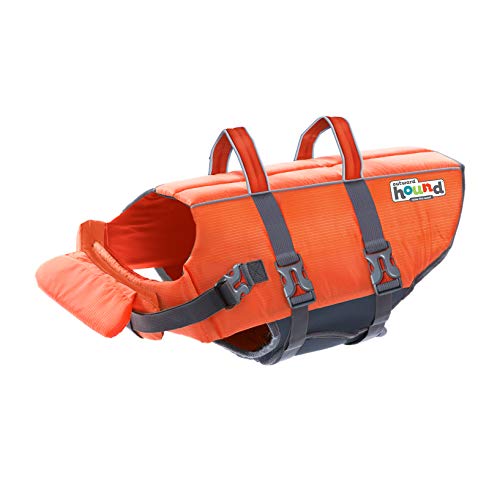
Splash Orange, Medium
Leaving the Dog on the Boat
What do we do when we want to go places that don’t allow dogs? We can fortunately leave Mangaux on the boat.
Whether or not you can leave your dog on your boat will depend on your dog, and how comfortable they are on the boat, and being left alone.
We got Mangaux as a rescue dog, and he had separation anxiety. When we lived in a house, we had to leave him in a crate (as in full jail cell, can’t break out of crate). If we left him out of the crate, he would chew apart the door we come and go out of.
I was so concerned about leaving him alone on our boat, a monohull Hunter 450 Passage. We leave him down below, where he can’t see out the windows, and lucky for us, he would just go to sleep until we came back.
On a few rare occasions, he has climbed the companionway steps and we have found him in the cockpit upon our return. Thankfully, he doesn’t like the water, so we don’t worry about him jumping in.
Food and Treats
I’m including food and treats in this section, as it can be hard to find the same dog food from place to place, especially the more remote you go. It is also important to keep his food well sealed!
Before we sailed away from the United States, I made sure to stock up on the same dog food Mangaux has been eating his entire life.
We finally ran out of this dog food a couple of months ago, about 9 months after leaving the USA, and have transitioned him to an alternate dog food that we have found in Grenada, our current location. I plan to stock up on this dog food as best I can so I don’t have to keep switching his food.
Make sure you can properly store the supply of dog food, and keep it properly sealed.
We once bought a large bag of dog food on the islands, only to get to the boat, open it up and find out that it was infected with warehouse beetles! Yuck!
We quickly got the food off the boat and now make sure the dog food we buy is stored in well-sealed containers in case there are any lingering beetles on the boat.
Another option is to feed your dog healthy people food, such as plain chicken and rice. Consult with your vet on the best options for you and your dog.
In regards to treats, they are not hard to find in the Caribbean in grocery stores and pet stores alike. And of course, Mangaux will eat any treat you give him!
Medical Provisions
Another thing to consider when sailing with dogs is how long you will be gone sailing, and how easy it is to get your dog’s medications, such as heartworm, flea and tick medicines.
It is extremely important to keep up with these medications if you are traveling to different countries. They regularly want to see documentation on the treatment of heartworm, flea and ticks.
This is something else that I don’t like to change too often, so I like to stock up on at least a year’s supply when I can.
Baths, Hair Cuts and Nail Trims
No different than life on land, your dog will need their routine grooming of baths, nail trims and haircuts (as applicable).
Before we sailed away, I invested in a good pair of trimmers for dogs, scissors, nail clippers and plenty of shampoo.
After much practice since we left to sail full-time over 1.5 years ago, Mangaux’s haircuts are getting better.
I also learned a great nail trimming tip from the PetSmart in Ponce, Puerto Rico while shopping for better nail clippers. Mangaux hated getting his nails trimmed, so they told me to trim 1 paw a day, and give him huge accolades, attention and a special treat (in this case, a piece of cheese!) after his trimming. Boy did this work! Now nail trimming is much less stressful on both Mangaux and me.
Safety for Sailing Dogs
There are a few safety factors to consider when sailing with a dog on board:
- Dog Overboard
- Getting in and out of the living area of the sailboat (monohull)
- Dealing with the heat
- First Aid incidents
Dog Overboard
Several sailors will put up safety netting to help keep their dogs from falling overboard. The safety netting is attached to the life line around the deck of the boat.

- Comes in 10', 20', 30' and 50' sections
- Keep Kids and Pets Safe
- This price is for 50' section
In our case, Mangaux HATES the water. Yep, we live on a sailboat and he hates the water, but loves the beach! Go figure.
This is good news for us, as Mangaux won’t even go near the edge of the boat. We don’t have to worry about him falling or jumping overboard.
We have several cruiser friends with dogs who love to swim! They use this handy inflatable ramp that helps their dog easily get back on the boat.
Getting In and Out of the Salon on a Monohull
Our furry family members typically want to be wherever we are. And that means they may attempt to go up and down the companionway steps on their own.
This is likely not an issue for larger dogs, but something to keep in mind for medium and small dogs.
For our 25 lb dog with short legs, it is a challenge for him to go up the companionway stairs, but he will do it from time to time.
Factor in the sailboat moving at anchor or underway, and there is a high likelihood that he could fall down several feet below.
He won’t go down the stairs on his own thank goodness. He definitely would fall down the steps, and he knows it.
Larger dogs tend to have no problem with companionway stairs, and Mangaux’s larger four-legged friends have been able to go up and down the stairs with ease in a short amount of time.
For Mangaux, if we are concerned he may try to go up them when we are gone, we put his toy box on the bottom step to deter him from climbing the steps and getting hurt.


Dealing with the Heat
Living full-time on a sailboat without regular air conditioning (we do have AC that we can use when we run the generator, which we do occasionally, but not regularly) can get HOT!
It is especially hot when sailing in the summer months in Grenada and sailing in the Caribbean.
Just like you and me, your dog will acclimatize to the heat. But here are a few tips to help them battle the heat:
- Shade: If your dog likes staying on deck, make sure there is plenty of shade
- Fans, lots of fans! Keep the air moving inside the living area
- Cooling Mats are a great way to help keep them cool. Mangaux is often found laying on his cooling mat.
- Icy Treats: Freeze some of your dogs favorite fruits they like and give this to them as a cool treat
- Time your walks: We walk Mangaux early in the morning and later in the evening when the sun is just coming up and setting to keep him out of the extreme heat.
First Aid for Dogs
Just like we need a first aid kit onboard, it is a good idea to have some first aid supplies on hand for your dog.
In the last year and a half of sailing, things that have come in handy having on the boat include:
- Styptic Powder to stop bleeding fast: helpful if you are trimming your dog’s nails
- Children’s Chewable Benadryl: Consult with your vet, but mine advised me to keep this on hand for my dog for allergic reactions, or itchy skin.
- Medicated Shampoo: Living in the humid tropics can lead to irritated skin conditions. This medicated shampoo was provided to me by the St. George’s Small Animal Clinic helps Mangaux a lot.
- Ear Cleaning Solution: In addition to itchy skin, Mangaux has had an increase in ear infections in this humid environment. We keep both ear cleaning solution and vet prescribed medication on the boat for when they flare up. The vet in St. Martin, Cabinet Veterinaire de Bellevue, was great with Mangaux and helpful in keeping our supplies stocked.
You may also want to consider a first aid kit for dogs, that includes helpful things like a metal tick remover and insect sting relief pads.

Vet Approved First Aid Supplies to Treat Dogs & Cats in an Emergency
Sailing with a Dog
Just like we take extra precautions when going out to sea or on a sail, we should do the same for our furry family members.
On a Day Sail
We have trained our dog, Mangaux, to stay in the cockpit whenever we are underway. We have a raised center cockpit that keeps all of us away from the water.
When conditions get really rough, we attach him to a tether we keep in the cockpit so he can’t fall out. We have a nice anchor point on our arch that we run a leash through and attach him there.

Overnight Sailing
On overnight sails, such as when we crossed the Mona Passage on a 24-hour sail, we bring Mangaux down below with the person off watch. This allows the person on watch to focus on navigation, weather conditions and vessel traffic.
Seasickness in Dogs
We find that while we are actively sailing, Mangaux tends to get more clingy and does occasionally get seasick. He likes to sit in our laps, which can be a bit inconvenient when we are trying to adjust sails and do our routine engine checks.
We try to establish a safe place of his own to lay down in the cockpit, where he can still be near us.
If we are in rough or rolly seas, giving Mangaux a dose of Children’s Benadryl helps keep him calm.
Adjusting our Passages for the Dog
Since Mangaux will not typically use the bathroom on the boat, we try to keep our passages to day sails or short overnight sails around 18 to 24 hours.
Our longest sail was a 3-day sail from the Bahamas to the Dominican Republic. Due to the strict pet import requirements in Turks and Caicos, and the weather window we had, we opted for the longer passage.
As I mentioned above, we were both happy that Mangaux ended up using the bathroom in the cockpit on this passage (and was rewarded greatly for it!).
Another adjustment we need to make is where we decide to anchor. We are always checking to make sure there is a place to go ashore and walk Mangaux.
Most times this isn’t too big of an issue, but there have been a few times where finding a place to go ashore has proven difficult.
For example, when we were going down the Atlantic ICW, there is a stretch in North Carolina where it’s all marsh with no convenient land to take your dinghy to. This means more planning on where to start and stop your passage each day.
Keeping Up with the Paperwork
It is extremely important when sailing with pets to keep up with their vaccines and medical record and all other paperwork such as health certificates and import permits if traveling internationally, like sailing in the Caribbean with a dog.
When we sailed to Grenada with Mangaux, we submitted his pet permit application about 3 weeks before our arrival.
Vaccines and Medical Records
If you plan on sailing in the Caribbean with a dog, in addition to their routine vaccinations like the rabies vaccine and DHPP vaccine, you will also need to get a rabies titer test.
The rabies titer test can take approximately 6-8 weeks to get the results in the United States and is also rather expensive. We paid just over $600 for this test and vet visit.
If you get the rabies titer test while in the Caribbean, you can get the vet to send the test to Europe, which I’m told is much more cost effective than the United States.
I recommend that you keep several copies of your pet’s medical records to provide to the various Customs and Immigration agents if you plan to travel to the Caribbean. We actually had to provide the paperwork twice in the Dominican Republic, at each port we checked into.
We sail with a printer on the boat to be able make as many copies as we need. We use the Cannon PIXMA TR150 printer and it has worked flawlessly for over 2 years now.

- Portable
- Wired or Wireless
- 4.5 Pounds
- Print Documents and photos up to 8.5 x 11 inches that showcase sharp black text and vibrant details, including square and borderless prints
Health Certificates and Pet Import Permits
Several countries and the Caribbean, and the Bahamas, require health certificates and pet import permits prior to arriving in their country.
A health certificate is a document obtained from a veterinarian documenting that your pet is in good health to travel.
Oftentimes, the country requires this health certificate be issued within a certain number of days before your arrival. This takes extra coordination before deciding to sail off to a new island.
A pet import permit is a permit obtained from the country you plan to visit, often required to be obtained prior to your arrival.
Check each country’s requirements carefully, as some of them request 2-3 weeks (or more) of processing time before they will issue the permit.
Some countries will require you to submit your pet’s records ahead of your arrival. Upon arrival, your pet may need to be checked out by the country’s veterinarian before they will issue the pet import permit or allow your pet off your boat.
This is the case when sailing to St. Lucia with your dog. They will have an Inspecting Officer come to your boat or dock to check your dog and read the microchip before allowing them entry.
Note that the Bahamas has just updated their process for bringing a pet there and this process can now be completed online using Click2Clear. Here is a guide on how to use Click2Clear.
For these reasons, it is a bit more complicated to sail with a dog in the Caribbean as additional planning and paperwork is involved.
Pet Passport
If you are doing a lot of traveling to European countries or islands, then getting your pet a European Pet Passport can be very helpful. This keeps your pet’s vaccination records and health check-ups all in one booklet.
However, if you are sailing through the Caribbean islands, it is important to note that only European veterinarians are authorized to write in the passport.
We obtained a Pet Passport for Mangaux while we were in St. Martin, and both the vets in St. Martin and Martinique have documented Mangaux’s visits in it. However, we have since been to St. Lucia and Grenada and neither of these islands use the European Pet Passport.

Favorite Pet Gear for Sailing Dogs
In addition to the items listed above, here are a few more items that are extra helpful for boating with a dog:
- Dog Ramp for boat: This comes in very handy getting our dog on and off the boat at a dock
- Spill-proof dog bowl: We keep a couple of these on the boat, both inside the salon and in the cockpit
- Cooling Mat: This mat is cooler to the touch than the floor or towel to lay on. Mangaux loves it!
- Lightweight Escapable Harness: I love this harness because I don’t have to worry about pulling on Mangaux’s neck and it’s not too thick or heavy in the heat.
- Sealable Dog Food Container: Helps keep the critters out and keep the dog food fresh in these humid environments.
- Non-slip boat dog bed: This gives your dog it’s own space on the boat and it’s non-slip bottom helps keep it from moving around while underway.

|

|

|

|
|
Primary Rating:
3.5
|
Primary Rating:
3.5
|
Primary Rating:
3.5
|
Primary Rating:
3.5
|
|
$129.99
|
|
$38.95
|
|
FAQs about Sailing with a Dog
Can you go sailing with a dog?
Yes! With extra planning and paperwork for entering foreign countries, your dog can enjoy sailing as much as you do.
How do dogs do on sailboats?
Most dogs on sailboats do great, even on monohulls when heeled over. Keep them safely tethered in the cockpit and provide them water and cooling mats in the heat.
Should I take my dog on a boat?
Yes, dogs make great companions on boats. They are also added security while you are away or sleeping. Many dogs enjoy sailing as much as their owners do. However, keep in mind the extra challenges such as the paperwork and clearances into foreign countries.
Living with a Dog on a Sailboat?
Our dog loves his life on a sailboat, enjoying endless walks and discovering new beaches along the way.
While there are challenges like overnight sails, acclimatizing to the heat, and extra vet visits for health certificates, Mangaux has adjusted well and loves all of the extra time he gets to spend with Scott and me.
If you’re ready to bring your dog onboard, just keep in mind the extra preparation needed. Follow the tips here to keep your dog safe, comfortable and healthy for their future adventures.
Set your sails with your dog to the Caribbean or beyond and explore the waters and beautiful countries with your furry friend!
