Sailing With A Dog In The Caribbean: Ruff Times??
When we adopted Mangaux 10 years ago, we never would have dreamt that we would be living on a sailboat full-time with a dog, let alone sailing with a dog in the Caribbean!
We often joke that it is much easier for us to check into the various Caribbean countries than it is for our dog. Sadly, it is true.
But, in this article, I will share with you information to help you bring your dog on your sailing adventures in the Caribbean and hopefully avoid some of the frustrations we have encountered while trying to decipher what is required for each island.
This article will include the common vaccines required for each Caribbean island, as well as helpful links for any additional questions you may have.
Different Countries Have Different Rules

Each island has slightly different requirements for bringing a dog to their Caribbean country. And, unfortunately for us, these requirements are not always clearly spelled out.
We have also experienced that the requirements are not enforced the same from cruiser to cruiser as we check our dogs into the various Caribbean islands. For example, we know of cruisers who were able to clear their dog into St. Vincent and the Grenadines with a heartworm test a few months old (greater than the 7-day requirement), while others were denied an appointment without a heartworm test within 7 days.
The best thing to do is to plan ahead by reaching out to the official veterinary office for the country you will be visiting well in advance of when you plan to arrive with your dog. It is ok if you don’t know the exact dates of your travels that far in advance; make your best guess and update them as you get closer to your arrival.
You also need to keep meticulous records of your dog’s various vaccine records and health certificates, as well as plenty of copies so you can provide them upon request.
Required Paperwork
Speaking of records, what are the required documents for each country? Below is a list of the common requirements among the islands when sailing with a dog in the Caribbean.
1. Vaccinations
Rabies Vaccination and Certification
This vaccine is required in all of the countries we have been to or considered going to. Make sure your Rabies Certificate is up-to-date and includes the manufacturer of the vaccine, serial number, and expiration date. Countries do look for this information!
Not all of the countries in the Caribbean will honor the 3-year rabies vaccination. I recommend requesting the 1-year/annual vaccination so your dog does not have to get over-vaccinated (i.e., need the annual rabies vaccine after year 1 or 2 of the 3-year vaccine).
It is extremely important that you do not have a gap / let your rabies vaccination expire. I cannot stress this one enough! This may void the rabies titer test, which is extremely expensive and takes a long time to get results.
DHLPP (aka Canine Distemper) Vaccination
The vaccinations included in DHLPP are:
- Distemper
- Hepatitis / Adenovirus
- Leptospirosis
- Parvovirus
- Parainfluenza
These are annual vaccines. It is important that you do not let these expire.
2. Heartworm Test With Negative Results
Heartworm tests verifying that your dog is free of heartworms are typically valid for one year. However, St. Vincent and the Grenadines require this test to be completed within 7 days of entering the island. My experience is that other countries accept this test being completed on an annual basis, even if their requirements say otherwise.
3. Heartworm And Parasite Treatment & Flea And Tick Prevention
Several countries in the Caribbean also request verification that your dog is being treated for heartworm, tapeworm, and other parasites. This is typically discussed with the veterinarian you visit for your dog’s health certificate, and they can document the broad-spectrum anthelmintic (such as Sentinel) and flea and tick prevention (such as Credelio or Bravecto) you provide to your dog.
4. Microchip
A microchip is a tiny device that is embedded beneath your dog’s skin and provides your dog with permanent identification in the event they get lost and found. The microchip must be from a certified and ISO-compliant company. Mangaux has a Home Again microchip and we have had no issues with this microchip. Essentially, the microchip must be compatible with a scanner so the vet can get your dog’s microchip number for their records.
5. Rabies Titer Test
A rabies titer test is a test that checks for the presence of rabies antibodies in your dog’s blood and measures the effectiveness or levels of antibodies. It is used to determine if your dog is immune to rabies. The level of antibodies in your dog’s blood should be >/= 0.5 International Units per Milliliter (IU/mL) or higher.
This test is not required by all islands in the Caribbean; however, I highly recommend you plan ahead and have this test completed prior to sailing with a dog in the Caribbean.
Note:
The rabies titer test cannot be administered within 30 days of your dog receiving their latest rabies vaccine, so plan accordingly.
It took us 2 months to get the test results back after having Mangaux’s blood drawn. There are only a select few laboratories in the world that are authorized to do the rabies titer test. Ours was sent off to the Kansas State Veterinary Diagnostic Laboratory.
We brought Mangaux in for this test in September 2023 while we were still in Maryland, USA, and we got the results back in November 2023. It cost us approximately $600!
6. Health Certificate
A health certificate is an examination by a veterinarian verifying that your dog is in good health. Oftentimes, the country you are preparing to visit will request a health certificate from the country you are departing from, within a certain timeframe.
As you can imagine, the number of vet visits can start adding up fast as you sail to and visit each of the Caribbean islands. While I recommend following the requirements of each country, if we are traveling through countries in a relatively quick time frame, I try to make sure the health certificate I submit to the next country is not more than ~1 month old.
While getting ready for and sailing with a dog in the Caribbean, we visited 4 different veterinarians from December to May.
The veterinary offices in the Caribbean, as well as in Florida, when bringing a dog to the Bahamas, are very familiar with the health certificate paperwork and process.
7. Pet Import Permit
A Pet Import Permit is a permit issued by the governing veterinary office of the country you are planning to visit. For the countries that require a Pet Import Permit (not all countries do), it needs to be obtained either prior to your arrival or upon your arrival if you have to meet with a veterinarian for your dog’s clearance into the country. Either way, you will have to submit the paperwork mentioned above well prior to your arrival.
European Pet Passport
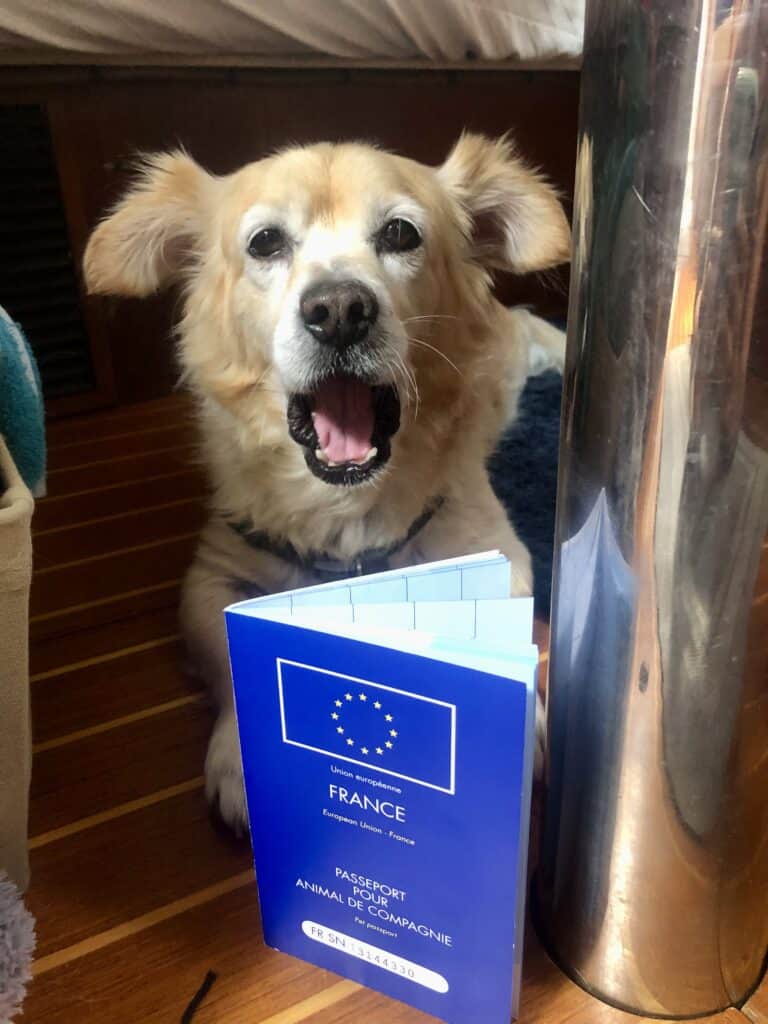
While researching the requirements for sailing with a dog in the Caribbean, I would often read about a European (EU) Pet Passport. While an EU Pet Passport is not required, it can be helpful when traveling with your pet to European countries.
An EU Pet Passport is a very well-organized booklet, the size of a passport, for your pet. It logs your pet’s visits with European veterinarians in a very organized fashion.
- Owner’s Name
- Name and description of pet
- Microchip information
- Vaccinations provided by European veterinarians
- Rabies titer test, when provided by a European veterinarian
- Anti-parasite treatment record
- Examination records
- Health check-up record
I went ahead and got Mangaux an EU Pet Passport while visiting a veterinarian in St. Martin. However, I have yet to use it. This is because only european veterinarians are allowed to make entries into the passport. Since we have visited several countries not in the European Union, Mangaux’s passport does not contain his updated records.
Also worthy of noting, the French islands, such as St. Martin, Guadeloupe, and Martinique, do not require you to submit or provide any records for you to bring your dog to their islands. I still recommend that you have updated records available in the event you were to get questioned.
Helpful Resources For Sailing With A Dog In The Caribbean
The first time sailing down the Caribbean chain with a dog can seem rather overwhelming. Here are some helpful resources that I referred to for additional information when I had questions:
- Sailing and Cruising with Pets Facebook Group
- Dogs Who Sail Facebook Group
- Pet Travel Website
- Caribbean Pet Website
Requirements By Country
I will be breaking down the requirements by country when bringing your dog to the Caribbean. These articles will be linked below when they are published in the coming weeks; stay tuned!
Bahamas

Required Documents
- Rabies Vaccination and Certificate
- DHLPP Vaccination
- Health Certificate
- Pet Import Permit
Bahamas Helpful Information
When traveling to the Bahamas, it is highly recommended to use a (very helpful) third-party service to obtain the Pet Import Permit and pay the fees associated with the permit. This is all explained in Bringing a Dog to the Bahamas.
For getting yourself and crew checked into the Bahamas, check out this tutorial for Click2Clear.
Grenada

Grenada Required Documents
- Rabies Vaccination within last 12 months
- DHLPP Vaccination within last 12 months
- Health Certificate
- Pet Import Permit
Grenada Helpful Information
Before bringing your dog to Grenada, you will need to apply for the Pet Import Permit – well in advance. They will issue and send you the permit prior to your arrival into Grenada.
St. Lucia

St. Lucia Required Documents
- DHLPP vaccination: no less than 14 days prior to export
- Rabies vaccination: no less than 1 month prior to entry
- Rabies Titer Test: unless coming from a rabies-free country for 3 months or more
- Microchipped
- Parasite treatment: no less than 14 days prior to export administered by vet from exporting country
- Tested negative for heartworm, Lyme disease, Leishmaniasis, Nipah virus and/or Hendra virus where applicable (countries endemic for these diseases) – no more than 14 days prior to export
- Health Certificate from exporting country
- St. Lucia Pet Import Permit
St. Lucia Helpful Information
Before sailing with your dog to St. Lucia, don’t forget to apply for the pet import permit in advance. They will issue and send you the permit prior to your arrival. Then let them know your port and date/time of arrival so the Inspecting Officer can meet your dog for an inspection.
Upcoming Articles:
Is It Worth It Sailing With A Dog In The Caribbean?

Short answer: yes! Being able to sail with our dog Mangaux has brought us so many wonderful experiences, as well as meeting so many wonderful dog owners doing the same thing we are doing.
Mangaux loves being with us and living on a boat, and especially loves going to his favorite place – the beach! He has visited so many wonderful beaches that he gets to run free on and explore.
However, it does take a lot of planning, often well in advance. Scheduling the various veterinarian appointments for health certificates, keeping up with vaccinations, and filling out and submitting the paperwork for the pet import permits to the countries that require them means staying on top of your game!
We are learning that it does get easier after the first time bringing your dog to the various Caribbean islands and having an idea of what to expect and who to reach out to. Although, we have learned that visits and implementation of requirements can vary based on the day and representative you are working with in each country.
I hope your dog loves the Caribbean beaches as much as Mangaux does and that this article helps you bring your dog to the Caribbean!
We would love to hear about your experiences, as I know they can differ from person to person. We would also love to see your furry friends – tag us on SV Pelagia’s Facebook or Instagram.
